
St. Johns River Lighthouse
A historic Mayport Village landmark with a future worth saving


St. Johns River Lighthouse, 2026
St. Johns River Light Station, 1929
The St. Johns River Lighthouse, first lit in 1859, has guided generations of mariners through the mouth of the river at Mayport Village. The keepers and their families were an integral part of village life as they protected lives and commerce in service to their country. Today, whether their stories will be remembered and the structure itself are both at risk, but the Mayport Lighthouse Association is working toward a bold future: relocating, restoring, and reopening this landmark to the community.
Why the Lighthouse Needs Saving
Although the St. Johns River Lighthouse still stands, its current location presents major barriers to preservation and public access. The Lighthouse is located on Naval Station Mayport, near active military operations, and is not open to the public. The bottom 8 ft. of the tower, including the original door, is buried under fill dirt making the lowest window the only access point. The last significant restoration was completed in 1982, and now almost 45 years later, the tower is showing signs of deterioration.
In 2025, we began a professional feasibility study to determine whether the St. Johns River Lighthouse could be safely relocated from Naval Station Mayport to a publicly accessible site in Mayport Village.
The study brought together preservation, architectural, engineering, and site-planning expertise to better understand the Lighthouse’s current condition, the proposed new location, and the technical requirements of relocation. The encouraging results confirmed an important next step in the effort to save the Lighthouse: relocation is achievable, pending the necessary approvals, permitting, and continued support.
Our Vision for the Future
Our mission is to move the St. Johns River Lighthouse to a City of Jacksonville waterfront site in Mayport Village, where it can be restored, interpreted, and opened to the public. The architectural illustration above conveys our inspiring vision of what this promising future could look like.
The Mayport Lighthouse project is more than a physical move — it is a bold act of stewardship. It honors the past, strengthens community identity, and promises educational and economic benefit for future generations.
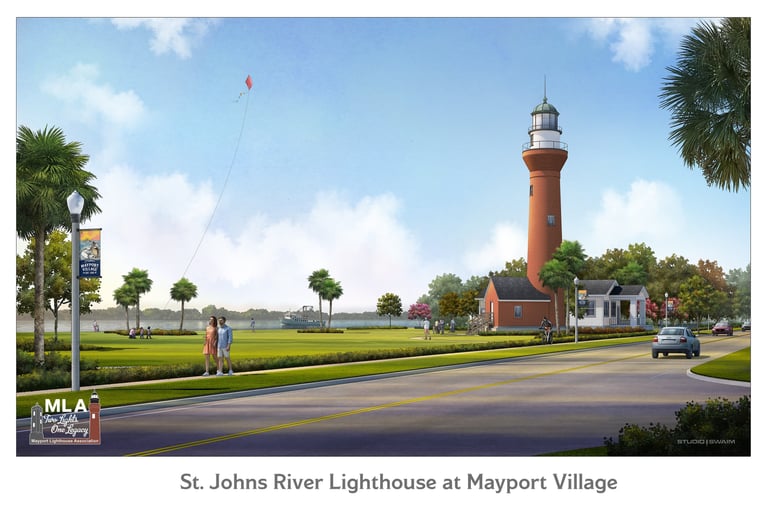

Renderings created by Studio Swaim
Frequently Asked Questions
Why move the Lighthouse?
Can you move a lighthouse safely?
Yes! There are several successful examples of historic lighthouse relocations:
In 1999, ICC Commonwealth, whose specialized structural engineers and structure relocation specialists were part of our feasibility study, relocated the Cape Hatteras Lighthouse, the tallest in the U.S., 2,900 feet inland to protect it from shoreline erosion.
Two lighthouses in Florida’s Panhandle region have been successfully relocated. Cape San Blas was moved 15 miles inland in 2014 to protect it from severe beach erosion, and Cape St. George was reconstructed in 2008 using the original bricks after it collapsed during a storm.
Southeast Lighthouse on Block Island, Rhode Island, and Gay Head Lighthouse in Massachusetts were successfully moved in 1993 and 2015, respectively, to save them from eroding cliffs. These relocations were also completed by ICC Commonwealth.
As an Affiliate Partner of the United States Lighthouse Society, the Mayport Lighthouse Association benefits from expert guidance in historic preservation, including structural relocations.
The St. Johns River Lighthouse currently sits on Naval Station Mayport, where the only access is through the lowest window. The original door is buried under 8 ft. of fill dirt that was added in the 1940s when the airfield was constructed. The condition of the portion of the tower underground is currently unknown and the lighthouse's location near an active runway and commercial vehicle inspection station places the structure at further risk. It also hasn’t had major restoration work since the early 1980s.
Public access is not possible at the current site due to military security and safety restrictions. Relocating it to the Mayport Village waterfront would preserve the lighthouse, make it accessible to the public, and contribute to the economic and cultural revitalization of the village. This move supports the vision of the Mayport Waterfront Partnership to strengthen the area’s identity as a working waterfront and historic maritime community.
Through the Years
The St. Johns River Lighthouse has stood for more than 165 years, witnessing generations of change in Mayport Village and along the River. First lit in 1859, the Lighthouse with its attached oil room looked different than the partially buried structure we see today, and the community around it has transformed many times over.
From its years guiding vessels through the mouth of the St. Johns River, to its decommissioning in 1930, to its current location on Naval Station Mayport, the Lighthouse has remained a rare and important link to Mayport Village’s and Northeast Florida's maritime past.
Today, the Mayport Lighthouse Association is working to relocate and restore the Lighthouse, return public access, and preserve Mayport’s rich maritime history for future generations.
2025
Courtesy of Atlantic Engineering Services


c. 1900
Courtesy of Florida State Archives


Post-1980's Restoration
Courtesy of Shepard Associates


Pre-1980's Restoration
Courtesy of US Lighthouse Society Archives
Timeline


1858
1830 and 1835
Construction Began on The Current Lighthouse
The tower was constructed farther from the shoreline to overcome the problems faced by its predecessors. This third lighthouse is the St. Johns River Lighthouse that still stands today.
Image: Map showing locations of second and third St. Johns River Lighthouses, State Archives of Florida (Labels added to photo)
The First and Second St. Johns River Lighthouses
The first lighthouse at the mouth of the St. Johns River was built in 1830 but was soon threatened by erosion. A second tower was constructed farther upriver in 1835, though shifting dunes and erosion eventually made it ineffective.
Image: Second St. Johns River Lighthouse, United States Lighthouse Society


August 1, 1859
The Lighthouse Is First Lit
The St. Johns River Lighthouse officially began guiding ships approaching the mouth of the river. A "Notice to Mariners" was published in major newspapers across the country.
Image: Architectural drawing of lantern room with lens, National Archives


Image: Notice to Mariners announcing the first lighting of the St. Johns River Lighthouse, Courtesy of Neil Hurley, Florida Lighthouses in the Civil War

1920's
July 10, 1861 -
July 4, 1867
Innovation Comes to Mayport
During the 1920s, the Lighthouse was electrified and equipped with a semiautomatic radiobeacon, the first of its kind in the United States.
Image: Newspaper clipping announcing the installation of a radio beacon a the St. Johns River Lighthouse, Key West Citizen, Library of Congress
The Civil War Years & Relighting
The Lighthouse was extinguished during the Civil War to prevent Union ships from using it to navigate the entrance to the St. Johns River. Following the war, the tower was fitted with a new Fresnel lens. Pictured above is a replica of the same type of lens that was installed in 1867 - Third Order Fixed.
Image: Replica third-order fixed Fresnel lens installed at Cape St. George Lighthouse Museum, Courtesy of Dan Spinella, Artworks Florida


1940's
May 5, 1930
Naval Station Mayport
The U.S. Navy acquired land that made up what was originally East Mayport, including the light station. The ground around the lighthouse was raised by approximately eight feet, burying its original entrance.
Image: NSM 1941, Florida Times-Union
The Lighthouse Is Decommissioned
After 70 years of service, the St. Johns River Lighthouse was decommissioned. It was replaced by the St. Johns Lightship LV-84, which had been stationed seven miles offshore in January 1929.
Image: St. Johns Lightship, State Archives of Florida


July 1980
June 3, 1976
Restoration Work Begins
Shepard Associates completed restoration work on the historic tower. Decades later, the lighthouse remains standing, but over 45 years later, further preservation work is needed to protect its future.
Image: Copper dome from top of lighthouse being lowered to ground by crane, Herschel E. Shepard Papers, Special and Area Studies Collections, George A. Smathers Libraries, University of Florida.
Recognized for Historical Significance
The St. Johns River Lighthouse was added to the National Register of Historic Places, recognizing its importance to Florida’s maritime and architectural history.
Image: National Register Plaque


Sign up for our quarterly newsletter and important updates.
Mayport Lighthouse Association, Inc.
PO Box 7148
Jacksonville, Florida 32238 info@mayportlighthouseassociation.org
501(c)(3) non-profit organization
REGISTRATION NUMBER CH67070
A COPY OF THE OFFICIAL REGISTRATION AND FINANCIAL INFORMATION MAY BE OBTAINED FROM THE DIVISION OF CONSUMER SERVICES WEBSITE [FDACSS.GOV] OR BY CALLING TOLL-FREE [800-435-7352]. REGISTRATION DOES NOT IMPLY ENDORSEMENT, APPROVAL, OR RECOMMENDATION BY THE STATE.
Dan Hogan, President
president@mayportlighthouseassociation.org
904-420-8839
Elizabeth Boggs, Vice President
membership@mayportlighthouseassociation.org
Beverly Oakes, Treasurer
treasurer@mayportlighthouseassociation.org
Valerie Bennett, Secretary
info@mayportlighthouseassociation.org